.png)

ABOUT Bladder cancer
Bladder cancer is the ninth most commonly diagnosed cancer worldwide and is responsible for approximately 220,000 deaths each year. Risk factors include tobacco smoking and occupational exposure to carcinogens. The prevalence is three to eight times higher than the incidence, making bladder cancer one of the most prevalent neoplasms and hence, a major burden for health care systems.
Aim of research
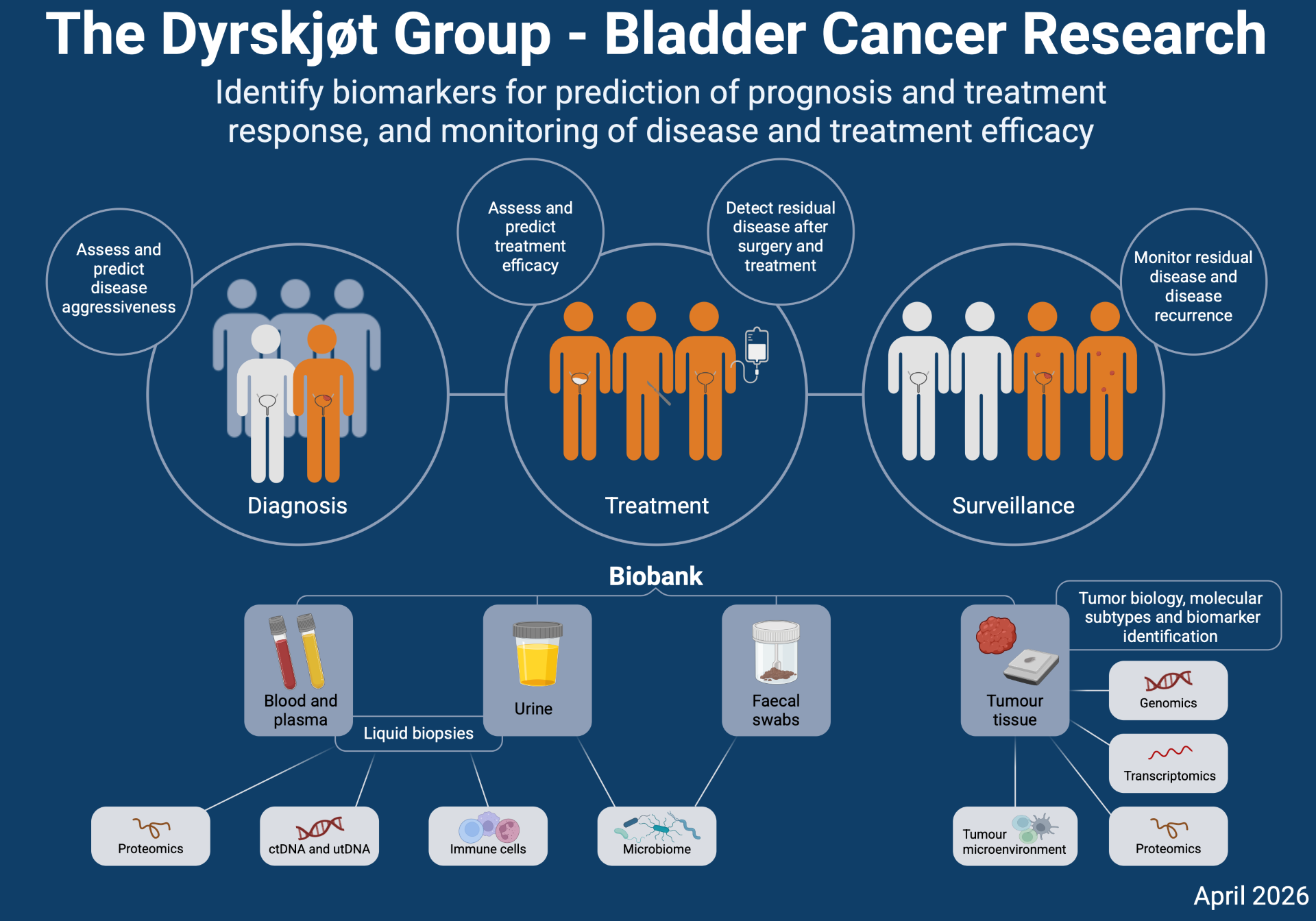
The Dyrskjøt group aims to enhance the biological understanding of urothelial cancer and translate this knowledge into molecular tools to predict disease outcomes, guide treatment decisions, and enable sensitive detection and monitoring of residual and recurrent disease.
Tumour biology
We analyse tumours using whole-exome, whole-genome and RNA-sequencing to investigate the mutational and transcriptional landscapes of tumours and how these affect disease development, aggressiveness, progression, and treatment response. As part of this, we have developed software for classifying non-muscle invasive bladder cancer tumours: nmibc-class.dk.
Liquid biopsies
We examine the use of circulating tumour DNA (ctDNA) and urinary tumour DNA (utDNA) as non-invasive biomarkers to improve disease staging, detect recurrences, and monitor treatment response. This work includes the TOMBOLA trial (NCT04138628), in which we use ctDNA monitoring to guide immunotherapy after removal of the bladder in patients with muscle-invasive bladder cancer.
Tumour microenvironment
We analyse tumour cells, immune cells, and other surrounding cells using spatial profiling techniques such as spatial proteomics and transcriptomics to understand their role and influence on cancer progression and treatment response.
Immune profiling
We study the role of the immune system in cancer development by analysing longitudinal blood and urine samples, as well as tumour samples, to understand how immune responses influence disease development, progression, and treatment outcomes.
Bacterial and viral infections
We analyse microbial signatures and viral signals in tumours, blood, faecal swabs, and urine, and investigate how prior infections and bacterial compositions may be associated with disease outcomes and treatment responses.
Biobanking initiative
The local bladder cancer biobanking initiative is fundamental to the group's work. Currently, the biobank contains more than 166,000 samples of tumour tissue, blood, plasma, and urine, and faecal swabs from more than 6,200 patients diagnosed with bladder cancer. Samples have been prospectively collected since 1994 in close collaboration with the Departments of Urology, Pathology, and Oncology at Aarhus University Hospital. All information is organised in a database, including detailed pathology information and sample characteristics. The biobanking initiative is now a part of the Bio- and Genome Bank Denmark (RBGB).
Selected methologies
- Whole-genome sequencing and targeted sequencing
- RNA-sequencing
- T- and B-cell receptor sequencing
- Spatial transcriptomics and proteomics
- Plasma and urinary proteomics
- Advanced bioinformatics and data modelling, including multiomics data integration
SOFTWARE
Whole-genome sequencing and targeted sequencing
NMIBC Classifier: nmibc-class.dk
An integrated multi-omics analysis identifies prognostic molecular subtypes of non-muscle-invasive bladder cancer
Lindskrog SV, Prip F, Lamy P, Taber A, Groeneveld CS, Birkenkamp-Demtröder K, Jensen JB, Strandgaard T, Nordentoft I, Christensen E, Sokac M, Birkbak NJ, Maretty L, Hermann GG, Petersen AC, Weyerer V, Grimm MO, Horstmann M, Sjödahl G, Höglund M, Steiniche T, Mogensen K, de Reyniès A, Nawroth R, Jordan B, Lin X, Dragicevic D, Ward DG, Goel A, Hurst CD, Raman JD, Warrick JI, Segersten U, Sikic D, van Kessel KEM, Maurer T, Meeks JJ, DeGraff DJ, Bryan RT, Knowles MA, Simic T, Hartmann A, Zwarthoff EC, Malmström PU, Malats N, Real FX, Dyrskjøt L.
Nat Commun. 2021 Apr 16;12(1):2301. doi: 10.1038/s41467-021-22465-w. PubMed
Group leader