.png)

About precision oncology
Precision medicine has delivered substantial advances in clinical care in oncology over the past two decades.
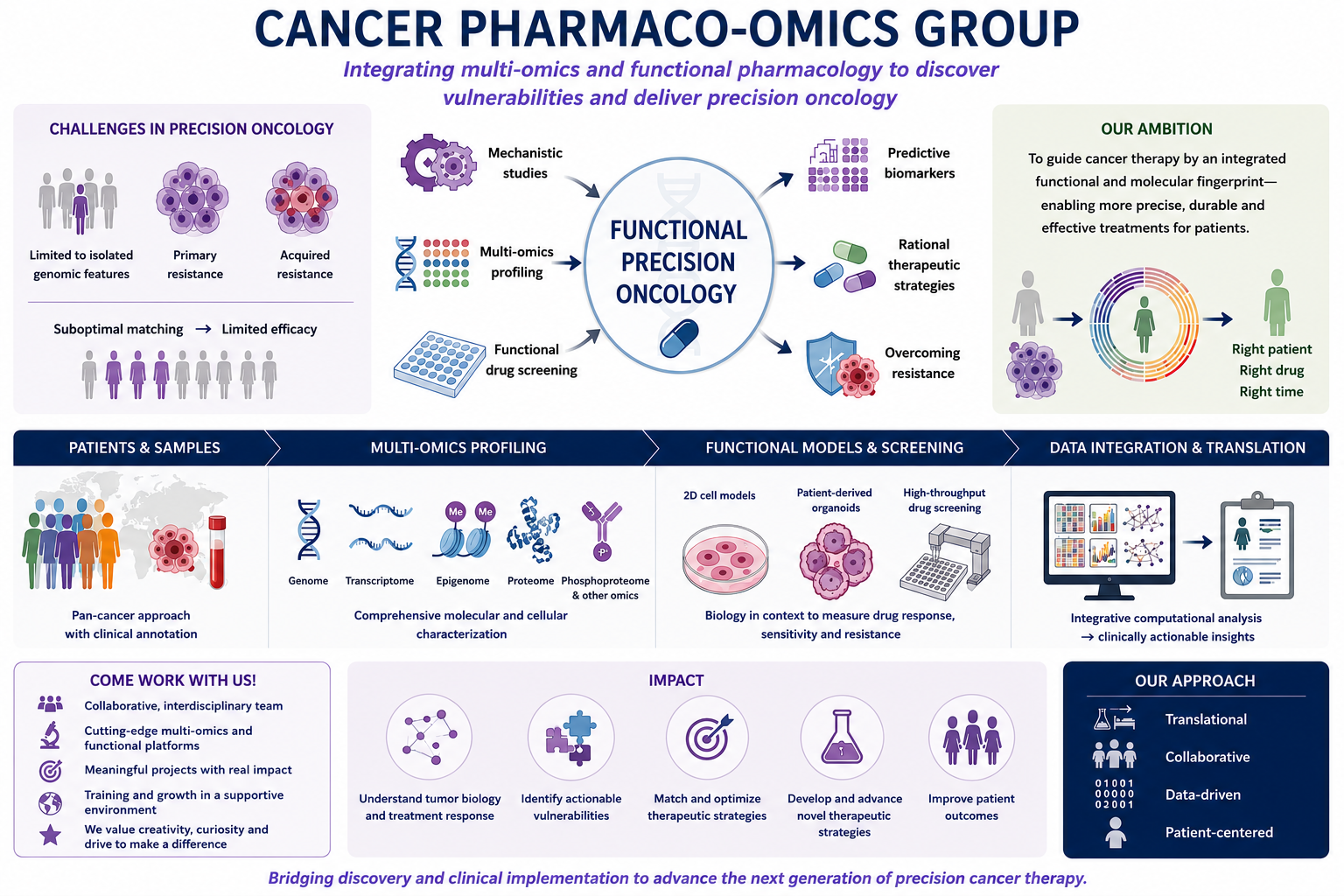
However, despite significant strides in next-generation sequencing techniques and big data approaches, the application of precision medicine in the clinic remains crude with only a panel of isolated genomic features considered when matching patients to targeted therapies.
Moreover, for patients that do match to treatment, both primary resistance and the emergence of acquired resistance, significantly limit the efficacy of treatment.
Our research is devoted to addressing some of these challenges, by employing mechanistic studies, as well as omics-based and functional precision medicine approaches.
AIM of research
Our group conducts translational cancer research at the intersection of molecular biology and clinical pharmacology, with a focus on improving outcomes through functional precision oncology.
Working in a pan-cancer framework, we explore how molecular markers and tumor biology shape treatment response and resistance.
Our work leverages multi-omics profiling, mechanistic studies, and medium- to high-throughput drug screening in 2D cellular models and patient-derived tumor organoids to identify predictive biomarkers and rational therapeutic strategies.
By integrating genomic, transcriptomic, epigenomic, and proteomic data with functional readouts, we aim to uncover clinically actionable vulnerabilities and facilitate evidence-based precision medicine.
By bridging basic discovery and clinical implementation, our ambition is to help shape a future where cancer treatment is guided not only by a tumor’s genomic profile, but by an integrated functional and molecular fingerprint—enabling more precise, durable, and effective therapies for patients.
Contact